Monday, 26 November 2012

To what extent are your chosen texts typical of their genre? (30 marks)

Text - Sin City


Sin City is recognised as a post-modern film as it is a hybrid genre, made up of various different genres including film noir, comic book and aspects of horror. 

There are many typical conventions of film noir, for example in an urban environment with damp streets and stormy weather being used as pathetic fallacy. In the text Sin City, this setting is prominent throughout the film, and an example of this is the scene when the prostitutes are shooting at the cops from the roof of the building. Another convention of film noir that links to this scene is


Monday, 22 October 2012

Film Directors

In both of my texts, the directors of them are male

This could be relevant in looking at a patriarchal filmmaking perspective and how they represent women

Sunday, 21 October 2012

Scenes for Research Investigation

The scenes below may be referenced in some form in my Research Investigation to show the stereotypes of teenage girls.


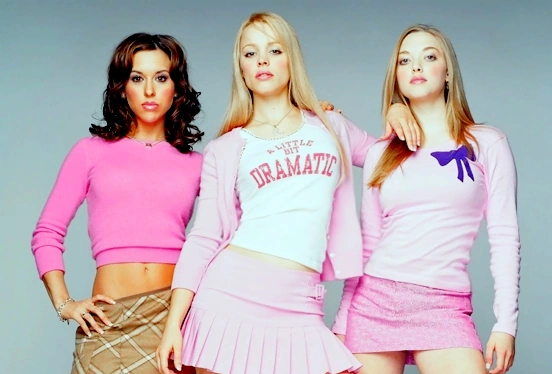
This is the Mean Girls cafeteria scene, mainly looking at high school stereotypes as opposed to specific teenage girls.


This clip looks at when Cady meets The Plastics, perhaps more relevant to teenage girl stereotypes.


Looking at the teenage girl stereotypes in Mean Girls at Halloween

This is when Olive first lives up to her new identity in Easy A


Olive and Brandon pretend to have sex, and when they're done Brandon is congratulated and Olive is ignored, thus showing that when boys have sex, they're seen as a 'stud' and girls are just seen as easy.


Monday, 15 October 2012

Representations

http://www.time.com/time/specials/packages/article/0,28804,2095385_2095462_2095500,00.html

http://representingteenagegirls.blogspot.co.uk/2012/03/ever-changing-representation-of-teenage.html

Friday, 12 October 2012

Stereotypes

"It seems that the typical teen movie’s female characters are, more often than not, projections of the archetypal male’s virgin/whore complex. Characters can only be one or the other, and there is no inbetween" (link)


Mean Girls - A Culture of Cliques


Thursday, 11 October 2012

Research from book

I looked at a book called 'Teen Movies: American Youth on Screen' by Timothy Shary and it has information in it that I could find useful when writing up my Research Investigation.

I particularly focused on Chapter 5 - 'The teen film takes on a new century. 1994-2004' This chapter has information that is more relevant to what I am researching because it is more recent.

Below are extracts I found especially interesting:
"Most of the recent representations of girls' roles in general reveal a cautious effort by the film industry to provide increasingly active images of young women, even if many tend to remain conflicted about their new senses of power" (pg94)

This quote implies that in cinema before the 1990's, females were generally portrayed as passive and not hugely important in the narratives.  However, recently they have been represented as more active, and where it says 'conflicted about their new senses of power', this is especially relevant for my two texts Easy A and Mean Girls. Olive (Easy A) and Cady (Mean Girls) both rise in popularity for different reasons and both characters also don't know how to handle their new senses of power, but clearly enjoy the attention for a while.
"Sexual pleasure for girls in teen films remains far more problematic than it is for boys, most likely because the majority of teen films are made under the patriarchal standards of Hollywood" (pg107)
This is relevant because in Easy A, after the rumour of Olive goes round about her losing her virginity and then incidentally another rumour about her sleeping around, she is considered to be 'easy', hence the title, and even adorns the letter 'A' on her chest, mimicking The Scarlet Letter. However, when she pretends to have sex with a boy at a party, he is considered a 'stud' of sorts and is congratulated for it. This perhaps shows that while female roles are getting stronger, there is also a small part of femininity that remains and they are expected to remain pure. On the other hand, by Olive playing up to this role could refer back to the previous quote of having a sense of power.


"After these portraits of girl groups in the mid-1990's, the film industry returned to more solo depictions of tough girls... which is perhaps most indicative of late 1990's tough girl roles, makes its heroine confident to the point of being self-centred" (pg93)
In Mean Girls and Easy A, many different tough girl stereotypes are portrayed, and the part of the heroine being confident to the point of being self-centred is certainly true of the main characters in both of the films, including roles of the antagonists such as The Plastics (Mean Girls) and Marianne (Easy A)


Wednesday, 10 October 2012

New investigation idea

I have chosen two new texts so that I can look at high school teenagers in American films

To what extent are the representation of teenage girls stereotypical in modern teen high school movies, focusing particularly on Mean Girls and Easy A


1. Easy A


After a little white lie about losing her virginity gets out, a clean cut high school girl sees her life paralleling Hester Prynne's in "The Scarlet Letter," which she is currently studying in school - until she decides to use the rumor mill to advance her social and financial standing.

(Taken from IMDB)


2. Mean Girls


Raised in African bush country by her zoologist parents, Cady Heron thinks she knows about survival of the fittest. But the law of the jungle takes on a whole new meaning when the home-schooled 16-year-old enters public high school for the first time and encounters psychological warfare and unwritten social rules that teenage girls face today.

(Taken from IMDB)


Wednesday, 3 October 2012

Example exam question

Explore the marketing strategies used by your selected industry. Use the examples you have studied to illustrate your answer. (30)

Research

Mad Men

- DVDs (All the seasons, also on Blu-Ray)
- Books (Fashion File, Sterling's Gold, The Illustrated World)
- Barbie Dolls (Of the main characters like Joan, Don, etc)
- Calendar
- CDS


Lost

- DVDs
- T-Shirts
- Books
- Mugs
- Ornaments


These marketing strategies will be used to help promote the programmes and will appeal to a wide range of audiences because of the variety of merchandise offered.


B3: How do your chosen texts attract their audiences?

B3: How do your chosen texts attract their audiences?

In the episode of Lost, there are various technical conventions that are used to attract a mass audience. For example, enigma codes are widely used across the episode to make the audience interested and to appeal to a wide range of people. When the little boy finds the handcuffs, the audience question about whose they are, which is further questioned when his father comes and he looks around the area as if someone will come and retrieve them. Non-diegetic music is also used at this point to enhance the enigma as it is a low tone and a slow speed as the information settles in the father's mind that there could be someone dangerous on the island with them. Referring to the Uses and Gratifications theory, it provides the audience entertainment because it's something that wouldn't happen so could be an escapism, but the enigmas also provide entertainment.

- Refer to Uses and Grats theory
- Look at how the audience responds to the various sequences
- Look at equilibrium and disequilibrium


UNFINISHED

Wednesday, 26 September 2012

Example Media Question

Most media texts target a range of different audiences. How true is this of your choice of texts?

Mad Men

Within Series 5 Episode 11 of Mad Men, it is clear that a range of different audiences are intended to be targeted. The way that this is done is through the representation of various characters within the show, how the storyline is meant to be perceived by the audience and the attitudes of the characters portrayed. Most people watching Mad Men are an active audience and offer a preferred reading.

The Uses and Gratifications theory is all about how the audience makes choices about how and when they consume media texts, In terms of Mad Men, there are particular scenes which may interest certain audiences for different reasons. For example, the scene when the men are discussing a business deal with a potential partner from Jaguar, the man makes it clear that the only way he will sign the deal is if Joan Harris, one of the female employees, spends a night with him. Audiences, particularly females, may get entertainment from this because it is shocking and also deeply contrasting to how the business world is today. Furthermore, personal identity may come into it because females may find reinforcement for their own values that women should be treated equally, and how Joan Harris and the men come across and their treatment of women could make a female audience's viewpoints on feminism even stronger and making their personal beliefs stronger. The scene may also provoke conversation between a male and female audience about their own beliefs, therefore creating social interaction which is also a part of the Uses and Gratifications theory.

The scene when Peggy has come up with a good idea for the business but gets rejected by Don with him throwing money in her face may allow an audience to personally identify with the situation, perhaps if they had been under appreciated by their boss in the past, which may also create social interaction between other audience members. This scene could also be used to gain information on how women were treated within a 1960's business.

Another scene which may target a range of different audiences is the end sequence when Peggy tells Don Draper (the boss) that she is leaving for another company and a better job. Focusing on the Uses and Gratifications theory, the information gained from this scene are ideas about feminism and how times are changing. Her leaving may allow an audience to personally identify with the situation and inspire a female audience because Peggy is taking control and her decision to find a better job sharply contrasts the way that Joan Harris was able to move up in the company. In addition to this, it may provide a female audience entertainment and also encourage social interaction to see Don Draper trying to regain dominance of the situation by saying things like, "Let's pretend every good thing that's happened to you here wasn't because of me" and trying to get her back. However, Peggy is in the dominant position as she is standing and he is sitting in a submissive position. By showing the audience that finally in a 1960's business, a woman is in control, it could mean that women in the audience may personally identify with the situation. Personal identity is a key factor within the Uses and Gratifications theory. Also, seeing Peggy walk into the lift after leaving Don's office may offer entertainment to the audience by seeing the sense of accomplishment in her face.